 Rationally
Speaking
Rationally
Speaking
A monthly e-column by Massimo Pigliucci
Department of Botany,
University of Tennessee
N. 4, November 2000 - "Intelligent Design - the Classical Argument"
 This column can be posted for free on any appropriate web site.
If you are
interested in receiving the html code, please send an email
Further reading:

Dialogues
Concerning Natural Religion, by David Hume
“In crossing a heath, suppose I pitched my foot against a stone and were asked how the stone came to be there, I might possibly answer that for anything I knew to the contrary it had lain there forever. ... But suppose I had found a watch upon the ground, and it should be inquired how the watch happened to be in that place, I should hardly think of the answer which I had before given, that for anything I knew the watch might have always been there.”
These famous words were written in 1831 by the Reverend William Paley (in Natural Theology: or, Evidences of the Existence and Attributes of the Deity, Collected from the Appearances of Nature) and constitute the best-known rendition of the classical argument from design for the existence of god. Essentially, Paley said that nobody would necessarily invoke a supernatural designer in order to account for the existence of simple rocks, but complex and marvelously functional objects such as eyes beg for an explanation that transcends natural laws. If there is a watch, there was a watchmaker; ergo, if there is an eye, there must have been an intelligent designer of that eye.
Unfortunately for Paley, the famous skeptic philosopher David Hume had already refuted his argument, more than 50 years before Paley’s formulation. In his Dialogues Concerning Natural Religion, Hume left it to his legendary character, Philo, to concisely explain what is wrong with the argument from design:
“The world plainly resembles more an animal or a vegetable than it does a watch or knitting-loom. Its cause, therefore, it is more probable, resembles the cause of the former. The cause of the former is generation or vegetation.”
It is interesting that the argument from design is still the most popularly cited reason for why people believe in god according to a survey by Michael Shermer published in How We Believe (2000). It is therefore important for us to examine more closely the structure of Hume’s critique and understand where exactly the intelligent design argument falls flat. In the exposition below I will add my commentary and examples to clarify each point, given that Hume’s language is at times obscure and obviously not up to date on our current knowledge of the physical universe.
One can discern six objections to the argument from intelligent design in a complete reading of Hume’s Dialogue:
1.
1 - The analogy between the universe and human artifacts is not
convincing. In the quotation above, Hume does not think that the universe
resembles a complex machine at all. While the regularity of the laws of nature
may superficially inspire the analogy, human artifacts are always clearly
designed for a function. It often takes quite a bit of imagination to see what
the purpose of some aspects of the universe really is. Biologist J.B.S. Haldane
once answered a reporter who asked what his study of genetics told him about
God: “He must have an inordinate fondness for beetles,” referring to the
hundreds of thousands of species of these insects existing for no apparent
purpose other than their own reproduction.
2.
2 - Intelligence is only one of the active causes in the world. Many
natural phenomena obviously do not require intelligence to occur. Tides, for
example, would hardly make a good choice for Paley, since their explanation in
terms of simple gravitational interactions does not require any intelligent
design.
3.
3 - Even if intelligence is everywhere operative now, it does not follow
that we can ascribe to it the origins of the universe. This is logically
true, and can be illustrated in modern terms if we imagine that somebody one day
demonstrates that life on Earth was seeded by a race of extremely intelligent
extraterrestrials. This, of course, would not make them gods, and would not
provide an explanation for the origin of the extraterrestrials, nor for the
universe as a whole. In fact, humans may someday do something of the sort,
without because of this being elevated to divine status (other than perhaps by
the simple-minded results of our own experiments).
4.
4 - The origin of the universe is a single unique case and so analogies
are pointless. This is a subtle but very good point: while we have plenty of
natural objects, organisms and human artifacts, we only have one universe.
Science can derive meaningful analogies by comparing populations of
objects or entities. While we may compare and contrast the attributes of rocks,
eyes, tides and watches, to what shall we compare the universe? Anything we
might think of would be comparing a part of the whole to the whole itself, and
we are unable to find another self-contained whole for comparison. We may
conceive of an omnipresent god as an analogy for the universe, but unfortunately
the analogy offers no insights of scientific value. It is also unlikely that the
analogy would help theology. Is god spherical or doughnut-shaped? Will god
expand forever from an explosive beginning, or does god alternate through phases
of expansion and contraction?
5.
5 - The analogy between human and divine mind is clearly anthropomorphic.
Nature resembles a mindless organism rather than a purposeful and intelligent
one. This is another way to put objection #1, this time by highlighting the
parochialism of a theology that would pretend to understand the mind of god
simply as a version of the human mind writ large.
6.
6 - The fruit of anthropomorphic thinking is a finite God. Here Hume
goes on the counter-attack by showing that if the argument from design is taken
seriously, one has to conclude that the god acting in the universe is very
different from the Christian variety. Since there is no independent argument for
the perfection of the designer, we have to judge its ability and character from
what we see of the universe. And to paraphrase Bertrand Russell, if I had
millions of years of time and infinite power and had come up with the universe
as we know it, I should be ashamed of myself.
Hume was a skeptic, but not a fool. He published his Dialogues on religion posthumously, in 1779. They are still one of the most lucid critiques of the most commonly used argument in favor of theism. And that, my friends, is true immortality.
Next Month: "Intelligent Design, the Modern Argument"
© by Massimo Pigliucci, 2000
Further reading:

Why
I am Not a Christian, by Bertrand Russell
Web links:
Natural
theology of William Paley, from The Victorian Web
An
Inordinate Fondness for Beetles, learn more on the animals that made Haldane
wonder about god’s taste

Visit Massimo's
Skeptic & Humanist Web
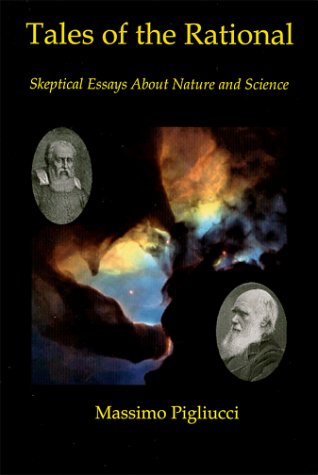
Massimo's latest book is Tales
of the Rational: Essays About Nature and Science