 Rationally
Speaking
Rationally
Speaking
A monthly e-column by Massimo Pigliucci
N. 10, May 2001: "The many faces of anti-intellectualism"
 This column can be posted for free on any appropriate web site.
If you are
interested in receiving the html code, please send an email
Further reading:

Richard
Hofstadter, Anti-Intellectualism
in American Life, simply a classic.
Universities
should not subsidize intellectual curiosity. This oxymoronic statement was
uttered by none other than then candidate for the governorship of California
Ronald Reagan in the late 1960s. The astounding thing is not that somebody like
Reagan would actually say something so outrageously stupid, but that this helped
him winning the election and ushering a new era of official anti-intellectualism
in America. This is continuing to this day, witness the fact that the current
president, George W. Bush, has run a campaign as the (Yale-educated!) champion
of the everyday man against the “pointed-head” intellectualism of rival Al
Gore.
Anti-intellectualism
has always been a powerful undercurrent in American culture, and it will
probably play a major role in our society for a long time to come. Regardless of
how depressing such thoughts might be, the first rule to win a war is to know
thy enemy; which is why I’d like to discuss the major types of
anti-intellectualism and how they threaten the very existence of a liberal
society.
Richard
Hofstadter, in a classic book on anti-intellectualism, first described the
phenomenon in its entirety, and what I succinctly propose here is an elaboration
on his main categories and on the more recent work of D. Rigney. The first kind
of anti-intellectualism can be termed “anti-rationalism.” This is the idea
that rational thinking is both cold (as in lacking sensitivity) and amoral
(which is apparently a bad thing, in some people’s mind not sufficiently
distinct from im-moral). The perception that scientists and philosophers—the
very paragons of rationalism—are cold and insensitive is as widespread as it
is false. If you know any individual belonging to these professions, you surely
realize that they can get as emotional as the guy next door. The idea that
rationality and emotions, science and poetry, cannot mix is simply unfounded. As
Richard Dawkins has pointed out in Unweaving the Rainbow, science simply
expands your ability to experience awe and wonder, it does not constrain it. As
for a-morality, this view is best summarized in the words of John Cotton (back
in 1642): “The more learned and witty you bee, the more fit to act for Satan
you bee.” I honestly never understood why God would not appreciate humor and
culture. Then again, there is that story of Eve and Adam stealing the fruit of
the tree of knowledge…
One
can be anti-intellectual also by rejecting intellectualism because it is
elitist. Anti-elitism is very peculiar to the American psyche, and it is
virtually unknown in the rest of the universe. Most other people recognize that
in matters of the intellect, as in any other human activity, there are people
who do it better and others who are not quite as good. That does not—and
should not—imply anything about the intrinsic worth (or lack thereof) of such
people. Astonishingly, Americans don’t have any problem with elitism per se:
just watch the adoring crowds at a basketball game and the recursive tendency to
set up athletes as “role models” for our youth. The underlying assumption
seems to be that everybody can become an Olympic athlete, but that the way to
science and letters is only reserved to the lucky few. Ironically, the truth is
quite the opposite: while the chances of making it in professional sports are
almost nil, a country with a large system of public education and some of the
best schools in the world can give the gift of intellectual pursuit to millions
of people.
Suppose
you are a mathematician and you are attending a cocktail party. Somebody
approaches you for small talk and asks: what do you do? Chances are
you’d rather answer that you are a traveling salesman than that you spend your
time contemplating problems in set theory. This is because you are afraid of a
third form of anti-intellectualism, unreflective instrumentalism. This is the
idea that if something is not of immediate practical value it’s not
worth pursuing. Hence, most of science and all of philosophy should be thrown
out the window. The root of this attack on the pursuit of knowledge is to be
found in capitalism at its worse. Andrew Carnegie, for example, once quipped
that classical studies are a waste of “precious years trying to extract
education from an ignorant past.” But the very idea of a liberal—not
politically, but as opposed to practical—education is that it is far better to
train somebody to think critically than to give her specific skills that will be
out of date in a few years. Yet, captains of industry are not interested in your
mental welfare; what they want is a bunch of mindless robots who are especially
adept at carrying out whatever tasks will turn the highest profit for the
stockholders. In this sense, intellectualism is a very subversive enterprise,
which explains its persecution by rogues of the caliber of McCarthy and Reagan.
I
recently had the pleasure and honor of attending a lecture by Kurt Vonnegut. He
asked the audience to remember one thing from his visit: start calling your TV
“the tantrum” and for God’s sake, turn it off and start talking to each
other. Or reading. The idea that intellectual pursuits are a lot of work and
that it is far easier and more pleasurable to watch TV is the fourth kind of
anti-intellectualism, unreflective hedonism. While I do not suggest to kill
your TV, as some radical friends of mine would want you to do, do try to read a
good book. I bet that the experience will be much more pleasurable than you
thought. A novel by Vonnegut might be a good place to start.
We
have net the enemy, and it is us, as Pogo concluded in the famous comic strip.
The most pernicious kind of anti-intellectualism comes from other intellectuals.
In recent years a movement called post-modernism (or decostructionism) has made
headway in humanities departments throughout the US and has been given a
sympathetic hearing by major media outlets. The idea is that knowledge is
relative because it is a cultural construct. So, you are equally fine if you
believe in evolution or creation, because these are both narratives
“constructed” by pockets of our culture. Of course, if everything is
relative and no theory has any particular claim to truth or reality, then why
should anybody believe deconstructionists? Postmodernism has actually been
imported in this country from France, and as philosopher Ted Honderich has
remarked, one can think of it as “picking up an idea and running with it,
possibly into a nearby brick wall or over a local cliff.”
What do we do about all this? Once again, the only available road is the long and tortuous path to education. But it should help knowing what we are dealing with before engaging in battle. Contrary to what a postmodernist might say, Napoleon really did loose at Waterloo, and it was because of poor intelligence on what the other side was doing.
Next Month: "God
on the highway"
© by Massimo Pigliucci, 2001
Further reading:
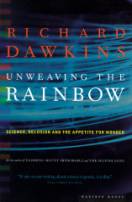
Richard
Dawkins, Unweaving
the Rainbow: Science, Delusion, and the Appetite for Wonder.
Web links:
The
Renaissance of anti-Intellectualism, by Todd Gitlin, published in The
Chronicle of Higher Education.
A
potentially controversial article: The
cult of anti-intellectualism amongst blacks, by Walter Williams, published
in Capitalism Magazine. Beware of your emotional reactions while reading
this one!
If
you want to get a kick about religious groups accusing each other of
anti-intellectualism go to Pentecostals
are anti-intellectual! And have some fun…

Visit Massimo's
Skeptic & Humanist Web

Massimo's latest book is
Tales
of the Rational: Essays About Nature and Science